
Uniting science, care, and community: highlights from the 2026 TSC Research Symposium
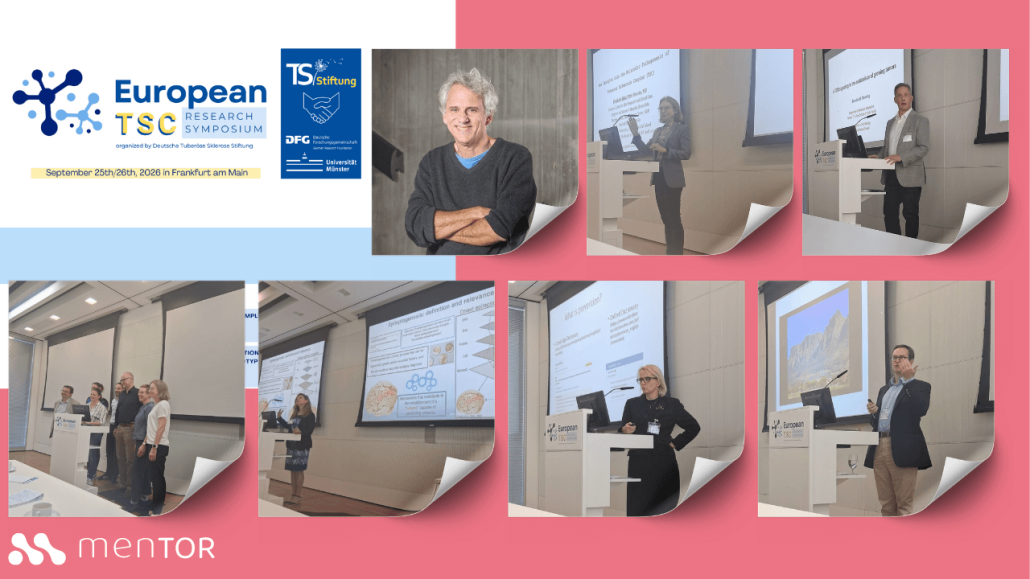
The 2026 TSC Research Symposium in Frankfurt brought together a world-class assembly of researchers, clinicians, European doctoral candidates from the menTOR MSCA Doctoral Network, and dedicated patient advocacy leaders for two comprehensive days of cutting-edge scientific exchange and collaboration.
Made possible by the generous funding and partnership of the German TSC Foundation (Deutsche Tuberöse Sklerose Stiftung), co-founded by Prof. Dr. h.c. mult. Roland Koch, alongside the TSC Patient Organization and the European E-TSC Patient Association, the symposium served as a premier European platform bridging molecular discovery with clinical practice in Tuberous Sclerosis Complex (TSC) and related rare disorders.
To explore photo galleries of this event visit this page.
Day 1: building foundations, structural insights, and network synergy
The opening day established a robust foundation, uniting senior investigators, early-career scientists, and patient advocates to address the multifaceted challenges of TSC.
- Patient advocacy and community engagement: Opening sessions underscored the vital partnership between researchers and patient representatives, featuring key contributions from Frank Wiech, the TSC Patient Organization, and the European E-TSC Patient Association, ensuring that research directions remain anchored in patient needs.
- Core mTOR signaling and molecular mechanisms: The scientific program featured deep dives into cellular regulation, metabolic control, and pathway mapping led by prominent investigators including Elizabeth Henske, Mario Pende, Kathrin Thedieck, Andrea Oekinghaus, Brendan Manning, Fried Zwartkruis, Costas Demetriades, Eleonora Aronica, Peter Janssens, Rozemarijn Kalf, Sara Mikhael, Morris Nechama, Afshin Saffari, Jacek Jaworski, and Stacey Bissel
- Translational pharmacology and Early-Career excellence: Cutting-edge therapeutic developments and structural biology approaches were showcased by Matthias Gehringer and Agnies van Eeghen. The program also spotlighted exceptional early-career research and flash talks from doctoral researchers across the network, including Seema Ouhadi, Victor Leichthammer, Shiwani Kumuri, Sonja Titze, and Tomasz Dulski.
Day 2: neurological frontiers and advanced therapeutic modalities
The second day shifted focus toward brain pathology, neurodevelopmental manifestations, and innovative therapeutic pipelines across two major thematic sessions.
Session 1: TSC and the Brain
- Petrus de Vries opened the morning with an authoritative keynote addressing next steps and clinical milestones in Tuberous Sclerosis-Associated Neuropsychiatric Disorders (TAND) research and practice.
- Mechanistic and cellular models of neurological dysfunction were advanced by Stephanie Dooves (investigating neuron-astrocyte interactions in iPSC-derived models) and Aleksandra Badura (exploring cerebellar-locus coeruleus circuits linking Purkinje cell loss to social behavior).
- Katarzyna Kotulska delivered a pivotal keynote on the prevention of epilepsy and major disease manifestations in TSC.
- Further neurological insights and animal/organoid models were presented by Agnieszka Wardak (fever-related hyperthermia in zebrafish models), Nina Gruetzmacher (investigating S6K in TSC-related epilepsy), and Oliver Eichmüller (uncovering neural activity changes using cerebral organoids).
Session 2: New developments in TSC research and care
- Mario Pende launched the afternoon session with a keynote exploring downstream mTOR activation across rare diseases and aging.
- Novel therapeutic strategies and molecular targets were presented by Stefan Imseng (highlighting new RAPTOR inhibitors), Nicola Alesi (examining RHEB modulation of mTORC1 localization), Matthias Gehringer (presenting selective S6K2 inhibitors), and Francesco Avanzi (investigating lysosomal exocytosis in extracellular matrix remodeling).
- Advanced experimental models were further explored by Ewa Liszewska (modeling TSC with human induced pluripotent stem cells) and Nadine Bernhardt (showcasing the Eker rat translational platform for TAND).
Looking Forward
The Frankfurt symposium demonstrated that accelerating progress in rare diseases relies entirely on synergy—connecting fundamental biology, translational networks like menTOR, clinical expertise, and patient advocacy.
The organizing committee and the entire network extend their warmest thanks to all speakers, session chairs, attendees, sponsors, and the dedicated team of organizers whose hard work ensured the event’s tremendous success.


